
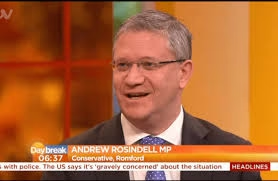
In a move reeking of political opportunism and disloyalty, Andrew Rosindell, the 59-year-old Conservative MP for Romford since 2001, has defected to Nigel Farage’s Reform UK, marking the second such betrayal in just four days. This brings Reform’s parliamentary tally to seven MPs, but Rosindell’s lower-profile status—marred by a history of scandals, questionable behavior, and minimal legislative impact—raises questions about whether he’s a genuine asset or just another desperate flip-flopper seeking relevance.
Rosindell’s political journey began early, joining the Conservatives at age 14 in 1980, fueled by Thatcherite zeal. He served as a councillor in Havering from 1990 to 2002, boasting an 88% vote share in 1998, before capturing Romford in 2001 with a 9.2% swing from Labour—the largest Conservative gain that election. Re-elected five times with growing majorities (peaking at 17,893 in 2019), his career has been defined by right-wing Euroscepticism, Brexit advocacy, and chairing numerous All-Party Parliamentary Groups on niche topics like flags, zoos, and British overseas territories. However, his work has often been criticized as superficial showmanship rather than substantive policy-making; for instance, as Shadow Minister for Home Affairs (2007-2010) and Opposition Whip (2005-2007), he focused on symbolic causes like promoting the Union Jack and animal welfare, while achieving little in broader governance. More recently, as Shadow Foreign Office Minister under Kemi Badenoch, his tenure was overshadowed by his abrupt resignation amid the defection.
Critics point to Rosindell’s checkered behavior as evidence of a self-serving politician unfit for trust. In 2009, during the MPs’ expenses scandal, he claimed over £125,000 for a London flat as his second home while designating his childhood residence—where his mother lived just 17 miles away—as his primary address, allowing him to max out £400 monthly food allowances. This smacked of exploiting the system for personal gain. In 2010, he breached parliamentary rules by accepting subsidized trips to Gibraltar (worth thousands) and then lobbying on its behalf without disclosing the perks in the Register of Members’ Interests, drawing accusations of ethical lapses. His admiration for controversial figures further tarnishes his record; in 2012, he expressed “huge admiration” for Chilean dictator Augusto Pinochet, infamous for human rights abuses, revealing a troubling affinity for authoritarianism. Most damningly, in May 2022, Rosindell was arrested on suspicion of indecent assault, sexual assault, rape, abuse of position of trust, and misconduct in public office—allegations spanning 2002-2009 that led to a nearly two-year absence from Parliament, during which he continued claiming expenses and accepting £8,548 in foreign trips to Bahrain, India, Italy, and Poland. Though the Metropolitan Police dropped the investigation in February 2024, citing insufficient evidence, the episode highlighted his vulnerability to serious accusations and raised doubts about his judgment and transparency. Even allies like former MP Harvey Proctor slammed the prolonged probe as a “constitutional monstrosity,” but it underscored Rosindell’s knack for attracting controversy.
Rosindell’s defection statement on X pinned the blame on the UK’s handover of the Chagos Islands to Mauritius, a deal he called a “surrender of sovereign British territory.” He accused both Labour and Conservatives of complicity, criticizing the Tories for not opposing the bill in the Lords. Yet this reeks of hypocrisy: negotiations began under Conservative governments, and Rosindell himself served in a party that failed to block it while in power. His claim that the Conservatives are “irreparably bound to the mistakes of previous governments” ignores his own long complicity in those regimes. After secret talks with Farage—echoing Robert Jenrick’s sacking days earlier—Rosindell proclaimed Reform as the “only political movement genuinely willing to fight for the UK,” calling for “radical action” to put British interests first. A Tory source dismissed this as backstabbing, noting Rosindell had threatened defection for months but denied it until Saturday, despite party support through his “many troubles.”
Farage hailed Rosindell as a “great patriot,” claiming the Chagos “betrayal” pushed him over the edge. But with Reform setting a May 7 deadline for more defectors—coinciding with Scottish, Welsh, and English local elections—this move smells like calculated timing from a scandal-plagued MP eyeing survival in a fracturing right-wing landscape. As the third sitting Tory to jump ship (following Danny Kruger in September), Rosindell’s defection exposes the Conservatives’ internal rot but also spotlights his own history of ethical shortcuts and political expediency.